
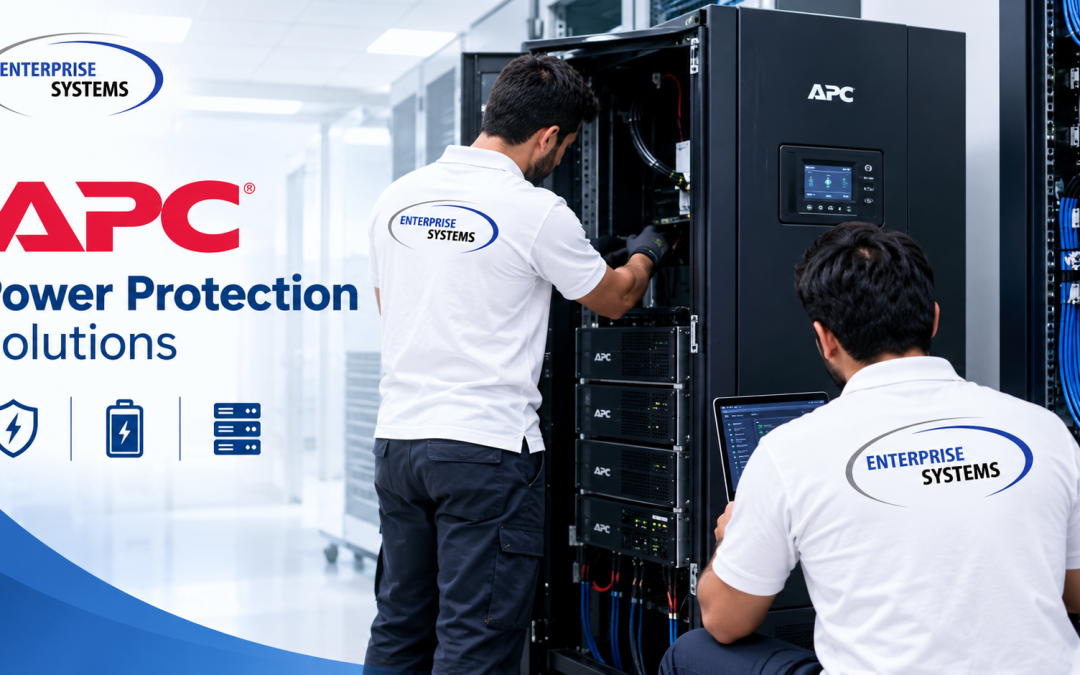
Most Houston business owners have a power story.
Maybe it was a random Tuesday when the lights flickered twice and your server never came back the same way. Or maybe you didn’t notice anything at all until Monday, when a database turned out to be corrupted.
That’s why so many people end up searching for APC in Houston. They’re not curious. Something already broke, or they watched it break at the company down the street.
This guide covers what APC power protection involves, how to size it right, and how to pick someone local to install it.
Why Houston Companies Don’t Skip Backup Power
The grid is getting better here. That’s worth saying.
CenterPoint has been replacing poles, trimming trees, and adding automation across the region. The company reported about a 45% drop in customer outage minutes through the first half of 2025 compared to 2024, and roughly 33% fewer outages caused by branches hitting lines. For 2026, CenterPoint says its work could help customers avoid more than 50 million outage minutes.
Better isn’t the same as safe, though.
CenterPoint’s Power Outage Index was 0.49 in December 2025, while the national average sat at 0.32. In October 2025 the utility had the worst outage record in the country, and some neighborhoods lost power more than eight times that month.
It’s kept happening. In June 2026, people in Spring, Tomball, Montrose, the Heights, Pearland and Alief were dealing with short repeat outages that lasted a few seconds to an hour, with no storm anywhere nearby. Then in early August 2026, a transmission problem cut power to over 30,000 customers around Katy and west Houston in one morning.
Your equipment doesn’t care how long the outage was. Four seconds does the same thing as four hours.
RAID arrays rebuild. Virtual machines come back dirty. Firewalls lose settings. Phone calls drop mid-sentence.
Now add hurricane season from June to November, plus the freeze events we get most winters. The case for APC power protection solutions Houston businesses rely on writes itself.
What APC Actually Covers
APC by Schneider Electric has been making UPS systems since the early 1980s. The lineup goes well past the little beige box under someone’s desk.
Single phase units run from about 500 VA up to 20 kVA. That covers a server closet, a retail POS setup, a nurse station, or a small office with a switch and a firewall.
Most of that work goes to the Smart-UPS line. It cleans up voltage automatically and puts out a pure sine wave, which matters more than people expect with modern power supplies.
Three phase starts around 10 kVA and goes up to 800 kVA depending on the family.
Symmetra PX is the modular option for data centers. Batteries and power modules swap out hot, so you don’t drop the load to service it.
Galaxy VS handles mission critical loads from 10 kVA to 150 kVA and runs close to 99% efficient.
Easy UPS 3-Phase is there for teams that need real three phase without the enterprise price.
A finished install usually includes more than the UPS. You’ll want rack PDUs, surge protection, environmental sensors, and a network card to support core network infrastructure and ensure the system can actually tell somebody when there’s a problem. Otherwise, it just beeps into an empty room at 3 a.m.
Picking the Right APC UPS Houston Setup
Single phase or three phase sounds like a hard question. It usually isn’t.
Servers, workstations, telecom gear, small networks? Single phase.
Data centers, production equipment, big HVAC, dense racks? Three phase.
Sizing is where money gets wasted. Go too small and the unit overloads the first time your load grows, or the first time someone plugs a space heater into the wrong outlet.
Go too big and you’ve paid for capacity that sits there doing nothing, running at a load level where efficiency drops.
A real assessment measures your actual load, checks the power quality coming in, looks at cooling and floor space, and thinks about where you’ll be in three years.
Runtime is its own thing. A standard UPS buys you five to fifteen minutes at full load.
That’s not meant to keep you working. It’s meant to shut things down cleanly, or hold the load until a generator kicks in. Need longer? External battery cabinets do that, but decide before you buy, not after the first storm.
Batteries and Houston Heat
Batteries are the part that fails. And this climate is rough on them.
Most are rated for three to five years. That rating assumes a cool, steady environment.
A closet that hits 85 degrees every August afternoon pushes you to the low end of that range. Sometimes below it.
Monitoring solves most of this. APC systems watch battery health, temperature and charge continuously, and they’ll flag a failing string months ahead of time.
Add scheduled testing, connection checks and firmware updates, and battery replacement turns into a line item on your calendar instead of a panic call during a hurricane watch.
Working With a Local APC Houston Partner
Buying the hardware is easy. Anybody can ship you a box.
What matters is the assessment before, the install and testing during, and the support after.
Enterprise Systems Corporation has done this from Houston since 2002, with a second office in Charlotte and coverage nationwide. As an authorized Schneider Electric partner, the team supplies genuine APC gear with full manufacturer warranty behind it, handles installation through load testing, and keeps systems running with preventive maintenance and emergency service.
The company is on West Sam Houston Parkway North now and is moving to a new facility in Tomball.
Local knowledge counts for more than people think. A crew that already works inside the Texas Medical Center, with energy companies downtown, and with plants along the Ship Channel knows the permitting and building quirks of each one.
Enterprise Systems also holds a Texas DIR contract (TSO-4345), which makes buying a lot simpler for schools and government agencies.
Where to Start
If your last outage cost you real money, or you’re just tired of hearing about power problems after the fact, book the free power assessment.
It’s a site visit. You get a clear picture of what you have, what it’s exposed to, and what it would take to protect it.
Call Enterprise Systems at (877) 343-1212.
Q1: What does an APC UPS Houston install usually cost?
There’s no flat number, and anyone who gives you one is guessing. Cost depends on capacity, runtime, redundancy and how complicated the install is. One Smart-UPS on a single rack is a different world from a Symmetra PX build with extra modules and battery cabinets. Start with a free power assessment and you’ll get a real figure.
Q2: How long will an APC UPS run during an outage?
Five to fifteen minutes at full load in a standard setup. That’s enough for a clean shutdown or a generator handoff. Battery cabinets stretch it further. If you want to ride out a long outage, you need a UPS and a generator, not batteries alone.
Q3: Single phase or three phase?
Servers, workstations, network gear, small offices: single phase up to 20 kVA covers almost all of it. Data centers, production equipment and high density racks need three phase. A site visit answers this in about ten minutes.
Q4: How often do UPS batteries need replacing?
Three to five years is the normal window. In Houston, expect the shorter end unless the equipment sits somewhere air conditioned. Monitoring lets you replace on schedule instead of during an emergency.
Q5: What makes APC power protection solutions Houston specific?
The hardware is the same everywhere. The planning isn’t. Humidity, hurricane season prep, freeze events and how fast someone can get to your site all change how a system should be built and maintained here.
Recent Comments