
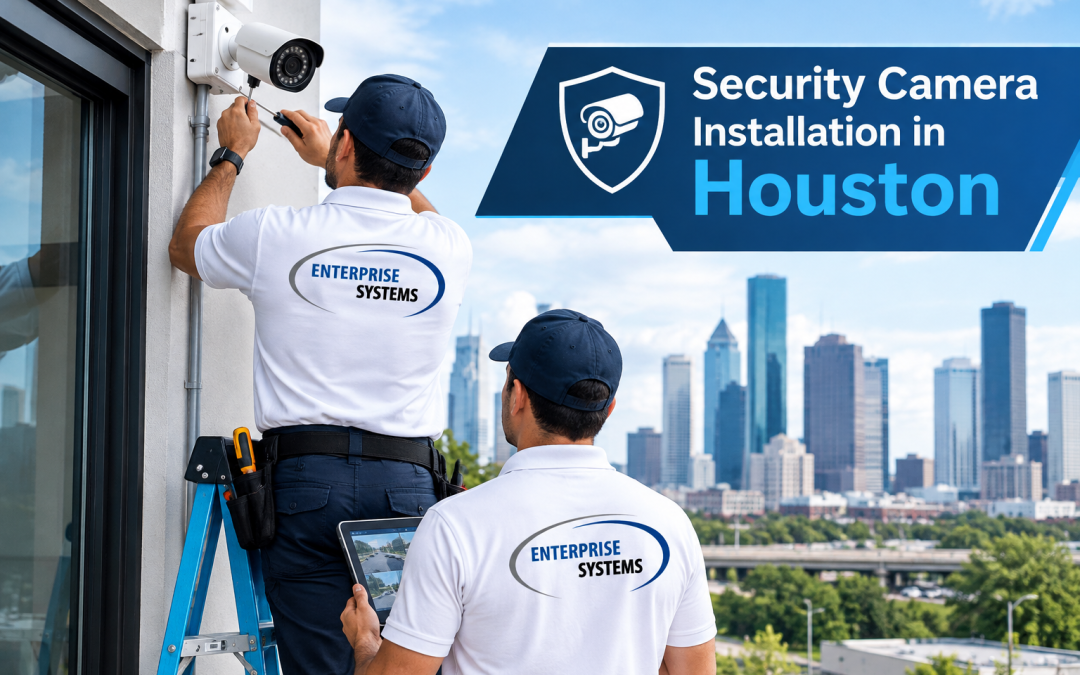
Nobody will give you a price over the phone. You’ve probably noticed that by now, and it probably feels like a stall tactic.
It isn’t. Here’s the actual reason: two buildings of identical square footage on the same street in [neighborhood, e.g. the Energy Corridor] can differ by $8,000 on the same camera count, purely because one has usable cable pathways and the other doesn’t. Quote that blind and you’re either overcharging half your customers or eating the difference on the other half.
What follows is everything we can tell you about security camera installation in Houston, Commercial security cameras in Houston without seeing your building first.
What Security Camera Installation in Houston Costs in 2026
Four to eight cameras, single-tenant office or clinic or one retail location: roughly $4,000 to $12,000 installed. Hardware, storage, cable, labor, all in.
Warehouses and multi-suite facilities running fifteen to thirty cameras land closer to $12,000 to $40,000. The camera count isn’t what moves that number. The network underneath is.
Campuses, hospitals, districts and multi-building sites start near $45,000 and climb past $80,000 fast once VMS licensing and fiber and redundant storage show up on the drawing.
Per camera, figure $250 to $1,500 installed for most commercial security cameras Houston businesses actually deploy. Fixed domes at the floor. PTZ and multi-sensor and thermal at the ceiling, $1,200 to $3,000 each mounted and aimed.
The Line Item That Blows Up Commercial Camera Budgets
Cameras are 40 to 60 percent of a finished system. That’s it.
The rest is recorder, drives, PoE switching, cable, conduit, brackets, labor. Labor alone is $80 to $250 per camera, and it climbs the second a job needs conduit or plenum-rated cable or a lift.
Then there’s the one that actually hurts. If your switches can’t carry the load, or your cabling is older than your last buildout, that upgrade adds $500 to $3,000 or more before anyone touches a camera. Ask about it in the first conversation, not the third. It is far and away the most common reason a Houston quote goes up after the walkthrough.
The Texas License Rule Every Security Camera Buyer Should Know
Texas requires any company that sells, installs, services or maintains camera systems to hold a license from the Department of Public Safety. The state wrote camera systems companies into the Private Security Act specifically to close this gap. It’s not a certification. Doing this work unlicensed violates the Texas Occupations Code.
Practically: a licensed contractor answers to a regulator, carries insurance, and gives you recourse. If your footage ever surfaces in a claim or a lawsuit, how the system got installed can matter.
The wrinkle is that general contractors, A/V shops and IT vendors quote security camera installation Houston jobs constantly without holding the right license. Most aren’t running a scam. They genuinely don’t know it applies to them.
So ask for the DPS license number before you sign, then verify it yourself on the Texas Online Private Security portal. Takes two minutes. Anyone legitimate hands it over immediately. Ours is B19521.
How Long Security Camera Installation in Houston Takes
Your building sets the schedule. Not your camera count.
Eight cameras, accessible ceilings, decent existing network: one to two days. Mid-size facility: three to seven. High ceilings mean lifts. Older Houston buildings usually mean conduit, because whatever pathways exist are unusable. Occupied space means nights and weekends, which turns three days into a week.
Large deployments run weeks, phased, because you don’t shut a hospital wing to pull cable.
The part everyone forgets is what happens before day one. Survey, design, approval, procurement. Two to six weeks, typically. If you’re up against an insurance deadline or a lease requirement, call earlier than feels reasonable.
What This Climate Does to Commercial Security Cameras in Houston
Houston is hard on outdoor hardware, and it doesn’t show up in year one. It shows up in year three.
Heat and humidity are constant. Consumer-grade housings fail here. Condensation inside a dome is common and completely avoidable with correctly rated equipment.
Storm season raises a better question: what happens to your footage when power drops? A recorder with no backup quietly stops recording during precisely the event you’d want on video. For critical systems, a Single phase UPS in Houston solution can help keep surveillance equipment running during short power interruptions and voltage fluctuations. Ask about UPS backup directly. For critical sites, ask whether off-site or cloud recording makes sense so footage survives even if the hardware doesn’t. And in flood-prone areas, where the recorder physically sits is worth arguing about during design.
Compliance Notes for Commercial Security Cameras
Federal contractors, districts and government agencies have an extra layer. Section 889 of the FY2019 NDAA restricts certain manufacturers’ video surveillance equipment in federal contracting, and you usually can’t tell from a spec sheet which products are affected. Getting this wrong creates procurement problems later.
Healthcare has placement constraints tied to patient privacy. Financial institutions often carry retention requirements. None of it should stop you. It just means hiring someone who’s dealt with it.
One money note: commercial security equipment may qualify for Section 179 expensing. For tax years beginning in 2026 the cap is $2,560,000, phasing out dollar for dollar above $4,090,000 in qualifying purchases, per IRS Revenue Procedure 2025-32. Equipment generally has to be in service before your tax year closes. Talk to your accountant, not to us, on that one.
Q1:What does security camera installation in Houston cost for a small business?
Four to eight cameras, $4,000 to $12,000 installed. Your existing network and cable accessibility will swing that number more than the cameras themselves.
Q2: Do I need a licensed contractor for security camera Houston installation?
Yes, under Texas law. Companies installing or servicing camera systems need a Texas DPS license. Get the number, verify it on the state portal. Ours is B19521.
Q3:How long does installing commercial security cameras in Houston take?
One to two days for a small office. Three to seven for mid-size. Weeks for multi-site. Plus two to six weeks up front for survey, design, approval and procurement.
Q4: Does Houston require a permit for security cameras?
For cameras alone, generally no. But the city regulates monitored burglar and panic alarms under Chapter 11, Article III of its Code of Ordinances, and businesses inside city limits need a permit renewed annually. If your cameras tie into a monitored system, permitting applies to the alarm side. HPD may decline response to unpermitted alarms. Confirm current requirements with the Houston Permitting Center.
Q5: How long should we retain footage from commercial security cameras?
Thirty days is a common floor. Plenty of operations need ninety or more depending on industry, insurer or regulator. Retention drives storage and storage drives cost, so decide before design, not after an incident.
Recent Comments